


Tested safety
Each lift table undergoes a careful final inspection before delivery.
Enquire about the most common variants
Get a free quote for your lift table with rotating platform in just two steps. Feel free to note any customizations, such as a different payload or dimensions, in the 'Change requests' field:

| Payload: | 1,200 | kg |
| Width: | 1,200 | mm |
| Length: | 2,000 | mm |
| Effective stroke: | 800 | mm |

| Payload: | 1,000 | kg |
| Width: | 830 | mm |
| Length: | 1,250 | mm |
| Effective stroke: | 800 | mm |

| Payload: | 1,500 | kg |
| Width: | 830 | mm |
| Length: | 1,250 | mm |
| Effective stroke: | 800 | mm |

| Payload: | by request |
| Width: | by request |
| Length: | by request |
| Effective stroke: | by request |

Where are lift tables with rotating platforms used?
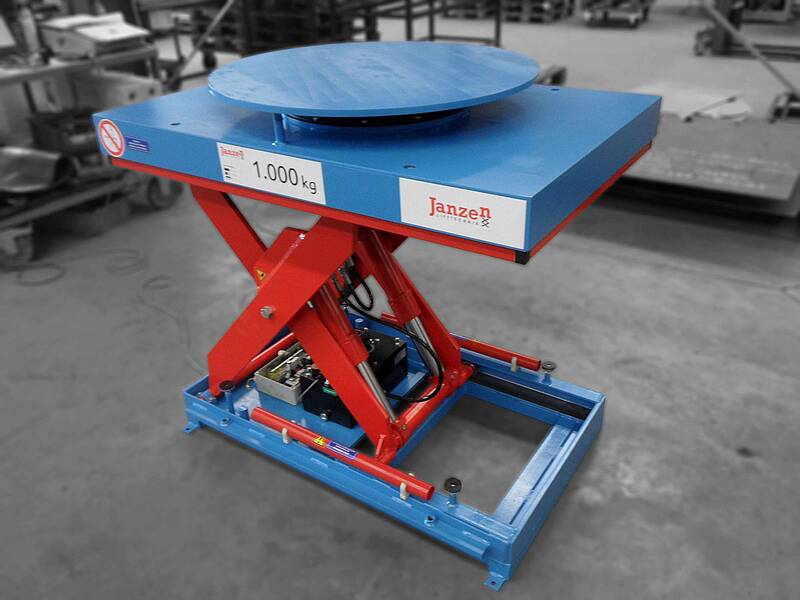
The concept of a lift table with a rotating platform is quite straightforward: It is a scissor lift table with an additional, rotatable platform mounted on top. But what are these lift tables needed for?
As an ergonomic workstation
The most common use case is as a work lift table. While a standard lift table is often sufficient to make the workflow more ergonomic and economical, there are areas where an additional rotating platform enables even more efficient work. For example, we can recommend the article Work lift table as an all-rounder: The combination of a rotating platform and extension allows for leaving the workstation permanently, leading to shortened production times for large transformers.
In automated conveyor systems
Another application is the process-related rotations within an automated conveyor line. When the direction needs to be changed within a conveyor system, switches and long curves are typically used.
However, if the necessary space is not available or the load being transported does not allow for such redirection, lift tables with rotating platforms and mounted roller conveyors are often used.
For handling the load from all sides
A good example is the use of one of our lift tables with a rotating platform for compacting materials: The scissor lift table lifts Big Packs layer by layer and regularly performs rotations, allowing the compactor to act on the Big Packs via plungers or press bars.
What can the rotating platform look like?
As we cover all steps from design to final assembly in our company, we are flexible in the design of the rotating platform. We have already supplied both square and round geometries, rotating platforms with surrounding border or with slots for the drainage of blasting media.
? We are available for personalized consultation to help find the solution that suits your needs. You can find the right contact person here.

Comparison of drive types
Three variants are available for the rotation drive of the platform:
The manual drive
Undoubtedly, the manual drive is the most cost-effective option. However, it is not only popular due to its cost advantage; in most cases, it simply makes sense.
For the bearing of the rotating platform we use a smooth-running ball slewing ring, allowing heavier weights to be rotated effortlessly depending on the platform size. If the load is not too heavy and the operator can easily access the lift table, we often recommend a non-powered rotating platform. The advantage: The operator can rotate the load at a suitable speed for them (which is often higher than the powered versions).
The electro-hydraulic drive
Hydraulic power transmission is fascinating: It not only allows lifting of heavy loads into the air, but also enables a rotating motion with the same drive.
This is the greatest advantage of the electro-hydraulic drive. Since we manufacture hydraulic lift tables, we always have a hydraulic power unit available, which we can also use for the rotating movement. Compared to an electromechanical drive, this allows for cost savings.
However, the necessary flow rate of the hydraulic swing bearings is a disadvantage: The speed of these rotating platforms is typically not very high, so it can take up to two minutes for a 360° rotation.
The electromechanical drive
Of all three solutions, the electromechanical drive is the most expensive, as it incurs costs for the swing bearing, an electric motor, a brake, and an interposed gearbox.
However, there are several advantages to consider:
- The speed of the rotating platform is significantly higher than with the electro-hydraulic drive. Therefore, the higher initial costs may potentially be offset by shorter process times.
- The speed is easily controllable: If different rotation speeds are desired, a frequency converter can be easily installed upstream, allowing the rotation speed to be adjusted almost continuously.

Fixation of the rotating platform
Especially when the rotating lift table is used as an assembly lift table, it can be beneficial to provide a fixation mechanism for the rotating platform.
For powered rotating platforms, blocking the rotation function is easily achievable. We always use rotary drives with self-locking or additional brakes to ensure that the rotating platform comes to a stop when the drive is switched off.
It becomes more complicated with manual rotating platforms. As a standard, we implement fixations using pressure balls, so that, for example, greater force is required to rotate the platform in the 0°, 90°, or 270° positions. The challenge here is to ensure that the additional force required does not become so great that intentional rotation becomes impossible.
Depending on the application, it may be advisable to use an electromechanical locking mechanism for manual drives: This allows rotation of the platform only after pressing a button.

How many degrees can the platform rotate?
All three variants of the rotation drives allow for endless rotations.
These are only limited by additional structures. For example, if an electrical control is needed on the rotating platform, it must be ensured that the cable is not affected by the rotation.

Lifting and rotating - is that all?
We've already mentioned our all-rounder: a lift table equipped not only with lifting function but also with a swing bearing, a chassis, and a sliding platform.
As you can see from this example, the lifting and rotating function doesn't have to be the end. Further customizations to meet individual requirements are possible. A brief overview is provided by our lift table accessories.