


- Durable and robust
Hot-dip galvanization and IP65-rated electrical components - Versatile
Suitable for outdoor use and damp rooms - Customisable
Size and features according to requirements
Personal project consultation:
+49 5939 96796-90
Or request a quote directly:
Professionally planned
Each enquiry will be reviewed and the offer tailored to your specific requirements.
Tested safety
Every work lift table undergoes a thorough final inspection before delivery.
Enquire about the most common variants
Get a free quote for your galvanized lift table in just two steps. Feel free to note any customizations, such as a different payload or dimensions, in the 'Change requests' field:

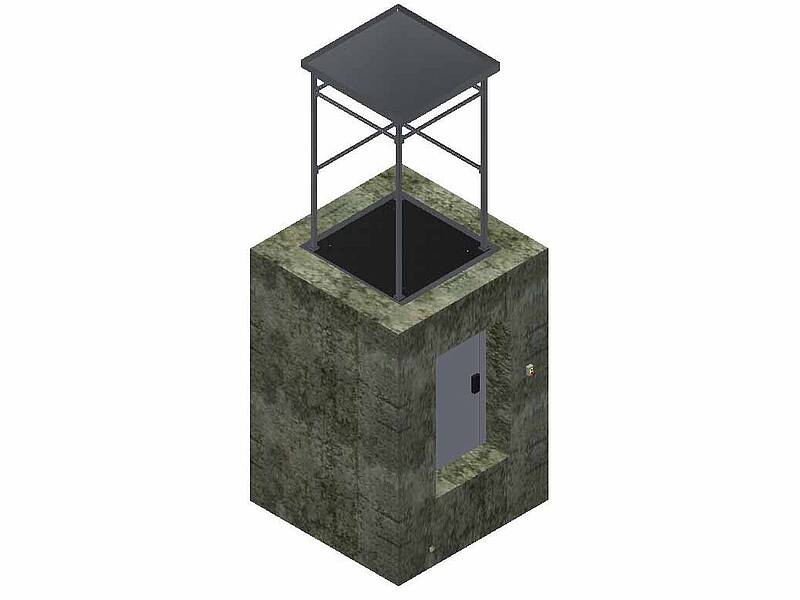
| Payload: | 700 | kg |
| Width: | 1,600 | mm |
| Length: | 1,620 | mm |
| Effective Stroke: | 2,820 | mm |

| Payload: | 6,000 | kg |
| Width: | 2,000 | mm |
| Length: | 3,200 | mm |
| Effective Stroke: | 900 | mm |

| Payload: | by request |
| Width: | by request |
| Length: | by request |
| Effective Stroke: | by request |

Why galvanized scissor lift tables?
All our scissor lift tables are available optionally with a galvanized platform and subframe. Combined with a special paint coating on the scissor, these lift tables are particularly suitable for applications where they are frequently exposed to moisture.
While good painting already provides sufficient corrosion protection, it has a significant drawback: it is not abrasion-resistant. This means that with each loading operation, the paint on the lift table can be slightly damaged, leading to insufficient protection over time. For this reason, we always opt for a hot-dip galvanized version for our lift tables for outdoor use.

High Flexibility
As mentioned earlier, we can offer all our scissor lift tables in a hot-dip galvanized version. It doesn't matter if it's a standard lift table with a load capacity of 500 kg or a custom scissor lift for 16,000 kg.
We are also flexible in terms of additional equipment.
For dock lift tables, for example, we can provide a foot control integrated into the platform instead of a manual control.
Additionally, platform railings, access doors, and many other options are available - in hot-dip galvanized execution for steel components, of course.
For a brief overview of our extras, you can visit our Lift table accessories page.

Hot-dip galvanized vs. electrolytically galvanized
When high corrosion protection is required, we have our steel components hot-dip galvanized. The significant advantage of hot-dip galvanizing lies in the strong bond between the zinc and the actual steel structure.
In contrast, with electrolytically galvanizing or thermal zinc spraying, the zinc only adheres to the steel components - there is no strong bond. This surface treatment can achieve thin coatings that are durable in mildly corrosive environments. Similar to paint, there is a risk of the zinc coating peeling off, leading to a loss of corrosion protection.
The situation is different with hot-dip galvanizing. Through the prior pickling of the steel and the high bath temperature, the zinc penetrates the structural steel, providing long-lasting and abrasion-resistant corrosion protection.

Hot-dip galvanizing - a cost-effective solution?
When it comes to achieving high corrosion protection, there are generally four options: an elaborate painting, the use of stainless steel or aluminum, or hot-dip galvanizing of components.
For a lift table used outdoors, a completely painted version is not recommended, as long-term corrosion protection is not guaranteed due to possible abrasion (especially on the platform).
While stainless steel or aluminum offer excellent corrosion protection, there are also disadvantages. Stainless steel is relatively expensive due to its material costs and intricate processing. Strict separation of stainless steel and structural steel must be maintained in our production to prevent possible corrosion at contact surfaces. A stainless steel lift table can cost about four times as much as a comparable hot-dip galvanized scissor lift table.
Aluminum, as a material, also incurs high material costs and involves complex processing. Additionally, the modulus of elasticity of aluminum is significantly lower than that of steel. To achieve the same load capacity and stability as with a galvanized lift table, a special custom design is required.
Thus, hot-dip galvanizing often provides the most cost-effective corrosion protection.