- Weather-resistant construction
Corrosion protection as required - Load capacities up to 10,000 kg
For pallets, machinery and industrial goods - Custom-designed
Dimensions and equipment as required
Personal project consultation:
+49 5939 96796-90
Or request a quote directly:
Which Configuration Is Right for Your Project?
Choose one of our preconfigured options or request a custom solution. You can specify different dimensions, load capacities and equipment options directly in the enquiry form.

| Payload: | 1,000 | kg |
| Platform length: | 2,400 | mm |
| Platform width: | 1,500 | mm |
| Lifting height: | 2,000 | mm |

| Payload: | 1,000 | kg |
| Platform length: | 1,500 | mm |
| Platform width: | 1,000 | mm |
| Lifting height: | 3,000 | mm |

| Payload: | 1,000 | kg |
| Platform length: | 2,500 | mm |
| Platform width: | 1,400 | mm |
| Lifting height: | 3,000 | mm |

| Payload: | as required |
| Platform length: | as required |
| Platform width: | as required |
| Lifting height: | as required |

When Is an Outdoor Goods Lift a Suitable Solution?
An outdoor goods lift can be a suitable solution if there is insufficient space inside the building for the lift system or if retrofitting a lift inside the building would require extensive structural modifications.
Installing the lift on the outside of the building allows multiple levels to be connected without taking up additional usable floor space inside the building.
Note: Our outdoor goods lifts are designed exclusively for transporting goods and materials. They are not intended for passenger transport.
▶ For general information on designs, applications and planning, see our “Goods Lift” product page.
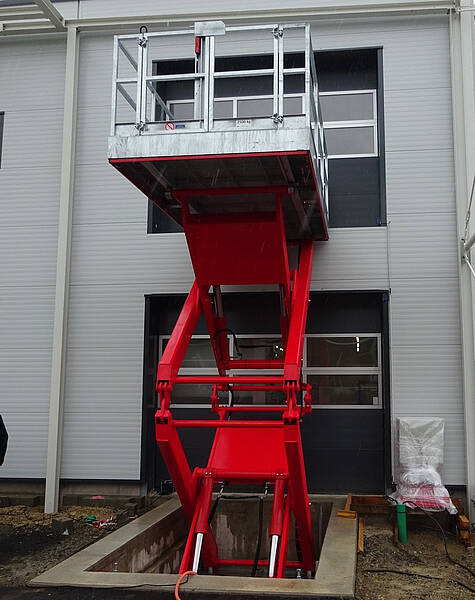
What Requirements Arise from Weather Conditions?
For an outdoor goods lift, moisture, temperature fluctuations, wind and the specific conditions at the installation site must be taken into account. The goods lift is therefore designed to suit the respective environmental and operating conditions.
The following aspects are particularly relevant when designing a goods lift for outdoor use:
- Corrosion protection: The platform, superstructures and other steel components are hot-dip galvanised or protected against corrosion by other suitable measures.
- Hydraulics: Hydraulic components and operating fluids are selected to suit the intended temperature range.
- Electrical equipment: Electrical components are designed for the respective environmental conditions and protected against external influences such as moisture and dust.
- Wind loads: For shaft structures, the wind loads expected at the specific installation site are taken into account during the design process.
- Drainage: If a pit is planned, the accumulation of rainwater or surface water must be taken into account. The required drainage must be planned according to the local conditions.
How Can an Outdoor Goods Lift Be Protected Against Unauthorised Use?
In addition to key switch activation, RFID access control provides another way to restrict operation of the goods lift to authorised personnel. Access is granted via a transponder, with the system verifying the user’s authorisation. The following video shows how operation is enabled using an RFID transponder.

What Structural Requirements Need to Be Considered for Outdoor Installation?
When planning an outdoor goods lift, the structural conditions at the installation site also play an important role alongside the load capacity, platform size and lifting height. These include the available installation space, access to the required levels, as well as mounting and foundation options.
If the installation requires modifications to the building or façade, these should be coordinated with the relevant specialist planners at an early stage. Whether the planned project requires planning permission or other building regulations approval must be determined based on the applicable local regulations.
We support you with the technical planning of the goods lift and provide the necessary technical documentation.

Goods Lift with or Without a Shaft?
Open configurations, goods lifts with their own shaft structure, or installation in a client-provided shaft are all possible. Which option is suitable depends on the technical and safety requirements.
For more information, see our article “When Can an Enclosure Be Omitted for Goods Lifts?”.
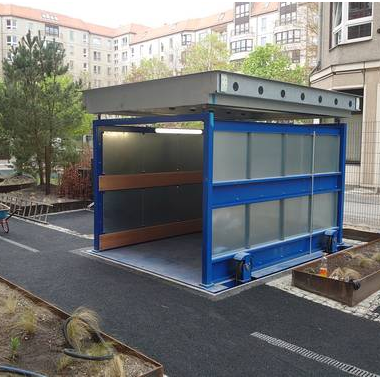
Underground Lift as an Alternative
If the area above the lift needs to remain usable, an underground lift can be an alternative. When fully lowered, the platform is completely recessed into the ground. Depending on the configuration, the top cover can be designed to be walkable or drive-over.
▶ Find out more about underground lifts
Frequently Asked Questions About Outdoor Goods Lifts
Can an Outdoor Goods Lift Be Used at Sub-Zero Temperatures?
Yes. With the appropriate design, operation at low outdoor temperatures is also possible. The components and operating fluids used must be selected to suit the intended temperature range. This includes, for example, selecting a suitable hydraulic oil.
Can a Goods Lift Be Retrofitted to the Outside of an Existing Building?
Yes. A goods lift can also be retrofitted to the outside of an existing building. The planning process must take into account factors such as the available installation space, access to the required levels, as well as any necessary modifications to the building or façade.
Does an Outdoor Goods Lift Require a Pit?
Not in every case. Whether a pit is required and how deep it needs to be depends primarily on the type and technical design of the goods lift. Certain configurations based on a column lift can also be installed without a pit. The height difference at the lower stop can then be overcome using an access ramp, for example.
For more information, see our article “ Planning of goods lifts: What pit depth is required?”.
What Information Is Required to Plan an Outdoor Goods Lift?
For initial planning, the required load capacity, platform dimensions, lifting height, as well as the number and arrangement of stops and access points are particularly relevant. The structural conditions at the intended installation site should also be specified. Based on this information, the appropriate configuration can be determined for the respective project.
Will I Receive an Approval Drawing Before Production?
Yes. Before production begins, you will receive an approval drawing containing the relevant technical data and dimensions of the goods lift. It also includes information about the intended installation conditions.
Is a CAD Model of the Goods Lift Available?
Yes. Once the order has been placed and the design phase completed, we can provide CAD data for the goods lift on request. Common formats include STEP, DXF, DWG and IFC.
This allows the goods lift to be integrated into existing planning documents.
Who Installs the Outdoor Goods Lift?
We generally carry out the installation of the goods lift on site. Our installation service is available throughout Germany and in neighbouring countries. Before delivery, we coordinate the necessary requirements and installation process with you. Client-provided work, such as constructing a pit and carrying out work on the building or façade, must be completed in accordance with the agreed plans. The specific requirements will be provided with the approval drawing.
How Long Is the Warranty for the Goods Lift?
As standard, we provide a 24-month warranty on our goods lifts when used within the EU. With an appropriate maintenance contract, this can be extended to up to 60 months.