


Table of contents
- 1. The start of every development: The customer's wish
- 2. The engineering department: Giving shape to the lift table
- 3. Machining: Precision from the start
- 4. Steel construction: The bigger picture
- 5. The welding department: Building strong connections
- 6. Surface coating: More than just paint
- 7. Final assembly: Bringing it all together
- 8. Final inspection: A thorough quality check
- 9. Shipping: Reliable delivery to its destination
- 10. Every contribution matters
What steps are necessary to manufacture a scissor lift table? How do our departments and employees work hand in hand to create a high-quality product? We aim to answer these questions and provide you with an exciting glimpse into our production process.
The start of every development: The customer's wish
Our passion lies in developing customized lift tables and goods lifts. The first step of every project is direct communication with our customers. Together, we analyze their specific needs and requirements, ensuring they align with our manufacturing capabilities and technical feasibility.
The engineering department: Giving shape to the lift table

Before production begins, our engineering department creates an approval drawing. This gives the customer the opportunity to view the planned implementation not only in text form but also as a 3D model. This early-stage visualization allows for questions to be addressed and change requests to be accommodated. In this way, we ensure the lift table meets the customer's expectations.
Once the customer approves the design, the actual production process begins. The designing engineer takes the lead once more: All necessary manufacturing documents are derived from the 3D model, including production drawings, packing lists and cutting lists. These documents facilitate the transition to the production phase.
Machining: Precision from the start

In the machining process, all required steel components are cut and processed using a variety of machines, ranging from automatic saws to CNC milling machines.
Our machining technicians work closely with the engineering department and the subsequent steel construction team. Precision is paramount in this department. The accuracy of individual components forms the foundation for the quality of our hydraulic lift tables.
Steel construction: The bigger picture

Craftsmanship and the ability to accurately interpret technical drawings are essential in steel construction. This is where individual components of the lift table are assembled into functional units. Milling, turning, and cutting parts are combined to create elements such as platforms or chassis. Each workstation is equipped with digital 3D models to support the manufacturing process efficiently.
Close collaboration with the machining and engineering department ensures that all steps are perfectly coordinated, resulting in a precisely aligned scissor lift table.
The welding department: Building strong connections

The welding department plays a crucial role in enabling the lift table to safely handle loads weighing several tons. As welders, craftsmanship, a steady hand and expertise in using shielded gas welding equipment are essential. Precise root welds and clean connections between components ensure the load capacity and durability of our products.
Our welders work closely with metalworkers, and the design engineer provides support when details about weld seams need to be coordinated.
Surface coating: More than just paint
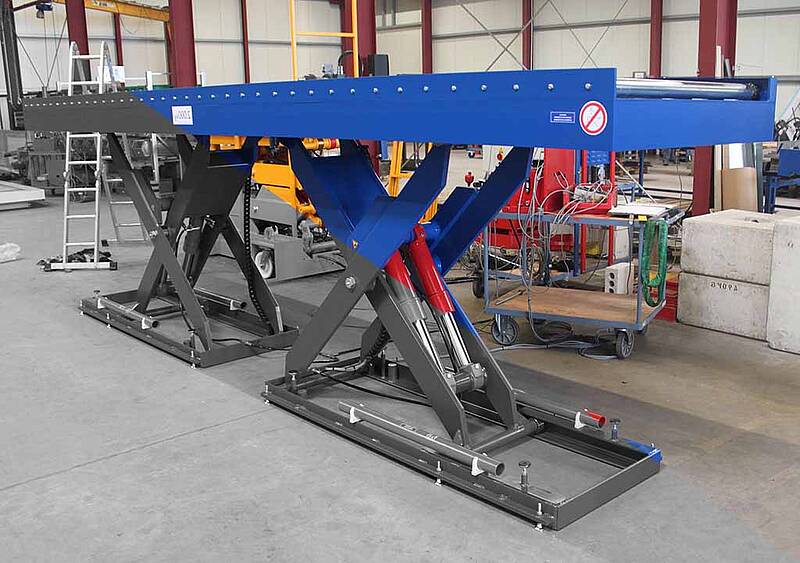
The surface coating of our lift tables fulfills two essential functions: providing an appealing appearance and ensuring reliable protection against corrosion. We rely on proven methods, including traditional wet painting and hot-dip galvanizing.
The choice of method depends on the intended use and location. For lift tables used outdoors — such as dock lift tables — we typically employ hot-dip galvanized platforms and base frames to ensure optimal protection against weather conditions.
Final assembly: Bringing it all together

In the final assembly, everything comes together: Mechanical, electrical and hydraulic components are combined into a fully functional system. The process is diverse, ranging from building the control system to the meticulous assembly of the scissor lift table.
In addition to extensive technical knowledge and skilled craftsmanship, attention to detail is paramount. Every bearing is installed with precision, carefully adjusted and expertly lubricated. Every screw is tightened and securely fastened, and each component is mounted with expertise. The result is a durable, reliable and safe lift table that meets the highest quality standards.
Final inspection: A thorough quality check
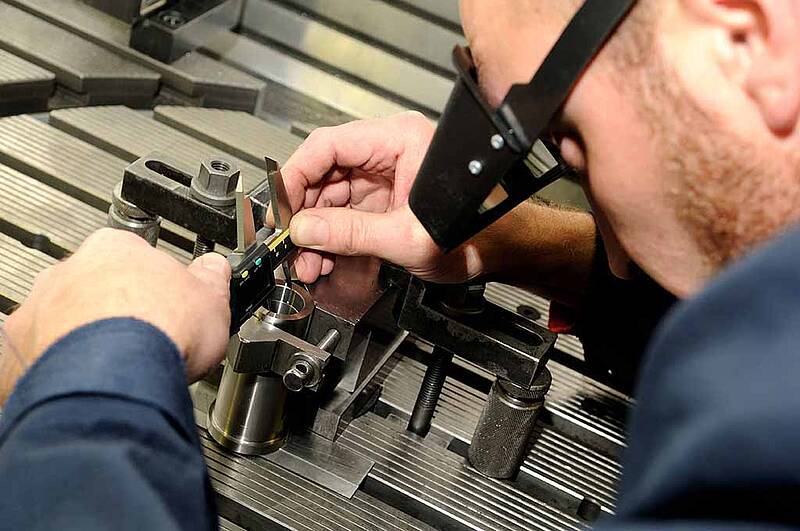
Before a lift table leaves our facility, it undergoes a comprehensive inspection based on a tailored testing plan. This includes load testing, verification of the surface coating and thorough checks of all safety features. This meticulous process ensures that every lift table meets both our standards and the expectations of our customers.
Shipping: Reliable delivery to its destination

Once the lift table is completed, it must arrive safely and punctually at the customer’s site. However, shipping is often more complex than it may initially seem. Many considerations require careful planning and strong organizational skills beforehand.
This involves coordinating the transport dimensions from production with the shipping details from sales to arrange the appropriate transportation. The following points, among others, need to be clarified:
- Can a 40-ton truck access the destination without issues?
- Does the customer have a forklift, or is a truck with a tail lift or a portable forklift required?
- Is a fixed delivery date necessary?
- On which days and at what times can the goods be delivered?
Precise organization is essential to ensure the lift table reaches its destination reliably.
Every contribution matters
This article provides an overview of the manufacturing process for our lift tables — a detailed description would go beyond the scope of this piece. At the same time, we want to emphasize that many additional supporting processes are essential for producing and delivering our lift tables. Every team member makes a valuable contribution — from answering the phone at reception to the on-site installation.
Does one of the tasks we’ve described sound exciting?
Take a look at our job opportunities. You might just find the perfect position. We look forward to meeting you.


Comments (0)
No comments found!